If you run a commercial kitchen or a busy dining room, you know that standard mopping only goes so far. Over time, grease, fats, and oils from cooking and foot traffic create a stubborn, slippery film that clings to the grout and the texture of your flooring. This isn’t just an aesthetic issue; it’s a major health and safety risk.
When restaurant owners search for the best way to handle this, the answer often involves professional intervention. Specifically, degreasing of floor tiles using industrial-grade equipment is the only way to ensure a hygienic, non-slip environment. At Token Cleaning, we recently completed a comprehensive project in Waterloo where we utilised high-performance rotary floor scrubbing machines to restore a restaurant’s floor to its original, safe condition.
Why Standard Mopping Fails in Restaurants
In a high-pressure environment like a Waterloo restaurant, the floor is under constant attack. Spilled cooking oils, animal fats, and carbonised food particles are trampled into the tiles. Traditional mopping—using a bucket and a string mop—often exacerbates the problem.
Instead of removing the grease, a mop frequently just redistributes a diluted layer of oil across the surface. This leads to:
- Slippery Surfaces: Even a “clean” looking floor can have a microscopic layer of grease that becomes incredibly dangerous when wet.
- Dirty Grout Lines: Grout is porous. As the mop moves across the floor, the dirty water settles into the lower grout lines, turning them black and harbouring bacteria.
- Odour Build-up: Trapped fats and proteins eventually go rancid, creating that “old kitchen” smell that no amount of air freshener can hide.
- Pest Attractions: Accumulated organic matter in the crevices of tiles provides a food source for pests, potentially leading to health inspection failures.
The Professional Solution: Degreasing of Floor Tiles
To truly sanitise a commercial floor, you need a chemical-mechanical approach. This means using the right degreasing agents combined with the physical power of a machine.
1. Specialist Chemical Selection
Not all degreasers are created equal. For our Waterloo project, we selected a professional-grade, alkaline degreaser designed to break down long-chain fatty acids. This chemical works by “saponifying” the grease—effectively turning the oil into a soap-like substance that can be easily lifted from the tile.
2. The Power of Rotary Floor Scrubbing Machines
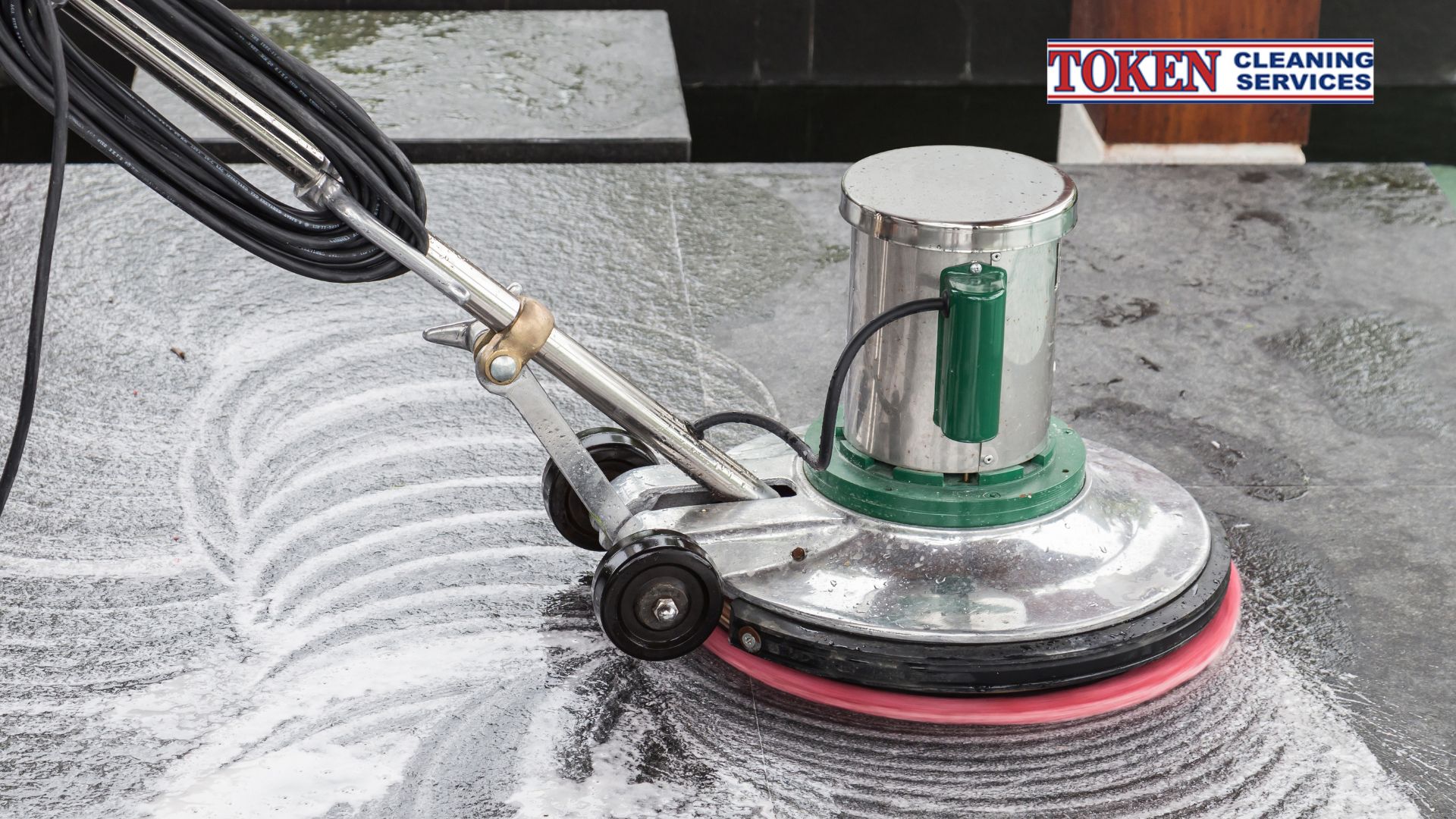
The mechanical heart of the process is the rotary floor scrubbing machine. These machines use heavy-duty, counter-rotating pads or brushes to agitate the cleaning solution deep into the texture of the tile and the pores of the grout.
The weight of the machine provides the “down-pressure” necessary to scrub away carbonised grease that a hand-scrub would never budge. By using a slow-speed rotary, we ensure maximum contact time and agitation without splashing chemicals onto walls or skirting boards.
Step-by-Step: Our Restaurant Floor Degreasing Process
When we were called to the site in Waterloo, the kitchen and prep areas had significant grease build-up that was affecting the safety of the staff. Here is how we tackled the restoration:
Phase 1: Preparation and Pre-Treatment
We started by clearing the area of movable equipment and furniture. A heavy application of our specialist degreaser was applied to the floor. We allowed this to “dwell” for 15 minutes. This dwelling time is critical; it allows the chemistry to penetrate the hardened layers of fat.
Phase 2: Mechanical Agitation
Using our rotary floor scrubbing machines equipped with medium-grade scrubbing pads, we worked across the floor in a systematic overlapping pattern.
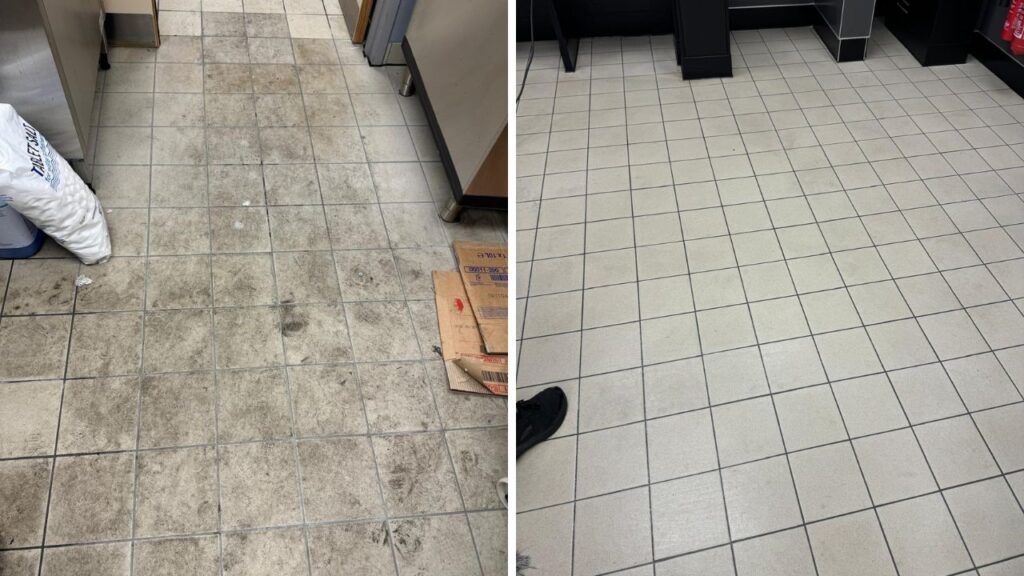
You could immediately see the clear chemical solution turning into a thick, grey slurry as the grease was lifted out of the tiles. We paid extra attention to “hotspots” like the areas surrounding deep fat fryers and the pass-through between the kitchen and the restaurant floor.
Phase 3: Extraction and Rinsing
Once the grease was suspended in the liquid, we used high-powered wet-extraction vacuums to remove the slurry. This is a vital step—if you let the liquid dry on the floor, the grease simply resettles. After extraction, we performed a secondary rinse with clean water to neutralise the pH of the floor, ensuring no chemical residue remained.
Phase 4: Grout Detailing
In areas where the rotary machine couldn’t reach—such as tight corners or under fixed cabinetry—we used hand-held oscillating tools to ensure the grout was as clean as the tiles.
The Benefits of Professional Degreasing
For a Waterloo business, the return on investment for professional floor cleaning is immediate.
- Reduced Slip Risk: The most important benefit. By removing the film of oil, the “Coefficient of Friction” of the tile is restored, significantly reducing the chance of staff injuries and liability claims.
- Improved Hygiene: Removing the organic food source for bacteria makes your kitchen a safer place to prepare food.
- Extended Floor Life: Grit and grease act like sandpaper under foot traffic. Keeping the tiles clean prevents premature wear and tear on the flooring material.
- Aesthetics: A bright, clean floor changes the entire “feel” of a restaurant, especially in open-kitchen concepts where customers can see the prep areas.
How Often Should You Degrease?
Every restaurant is different, but for high-volume establishments in busy areas like Waterloo, we recommend a professional deep clean and degreasing every 3 to 6 months. This prevents the grease from reaching a “critical mass” where it becomes a daily safety hazard.
In between professional visits, your daily maintenance team should use high-quality degreasing detergents rather than standard floor cleaners, and they should change their mop water frequently.
Why Choose Token Cleaning?
At Token Cleaning Services, we understand the logistical challenges of the hospitality industry. For our Waterloo clients, we offer:
- Out-of-Hours Service: We work through the night or during your closing hours to ensure zero disruption to your service.
- Specialist Equipment: Our rotary floor scrubbing machines are maintained to the highest standards, ensuring a deep clean every time.
- Health & Safety Compliance: We provide full RAMS (Risk Assessment and Method Statements) for every job, ensuring we meet your internal safety standards.
- Local Expertise: Having worked extensively in Waterloo and Central London, we are familiar with the specific drainage and access requirements of city-centre commercial properties.
In addition to our internal floor work, we also offer:
- Steam Pressure Washing: For external entryways and bin stores.
- Window Cleaning: To keep your storefront looking as clean as your kitchen.
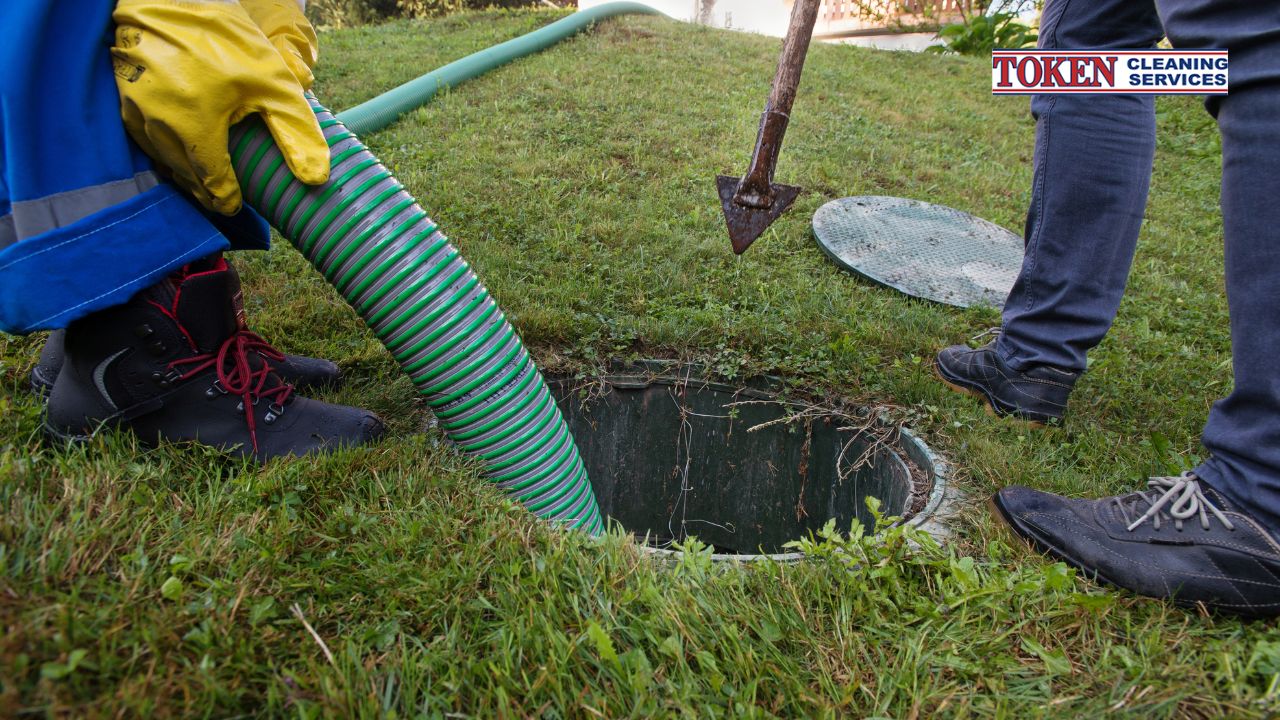
- Drain Cleaning: To ensure the grease we remove doesn’t end up clogging your pipes.
Conclusion
If you are asking, “How do you deep clean greasy restaurant floor tiles?” the answer is a combination of the right chemistry and mechanical power. Our recent project in Waterloo proved once again that while daily mopping is necessary, it cannot replace the deep-cleaning results of professional degreasing of floor tiles.
Don’t wait for a slip-and-fall accident or a disappointing health inspection to take action. A clean floor is the foundation of a successful restaurant.
Is your restaurant floor due for a restoration? Contact Token Cleaning Services today. We can provide a free site survey and a bespoke quote for degreasing your kitchen or dining room tiles using our advanced rotary floor scrubbing machines. Let us help you keep your Waterloo establishment safe, hygienic, and looking its absolute best.